
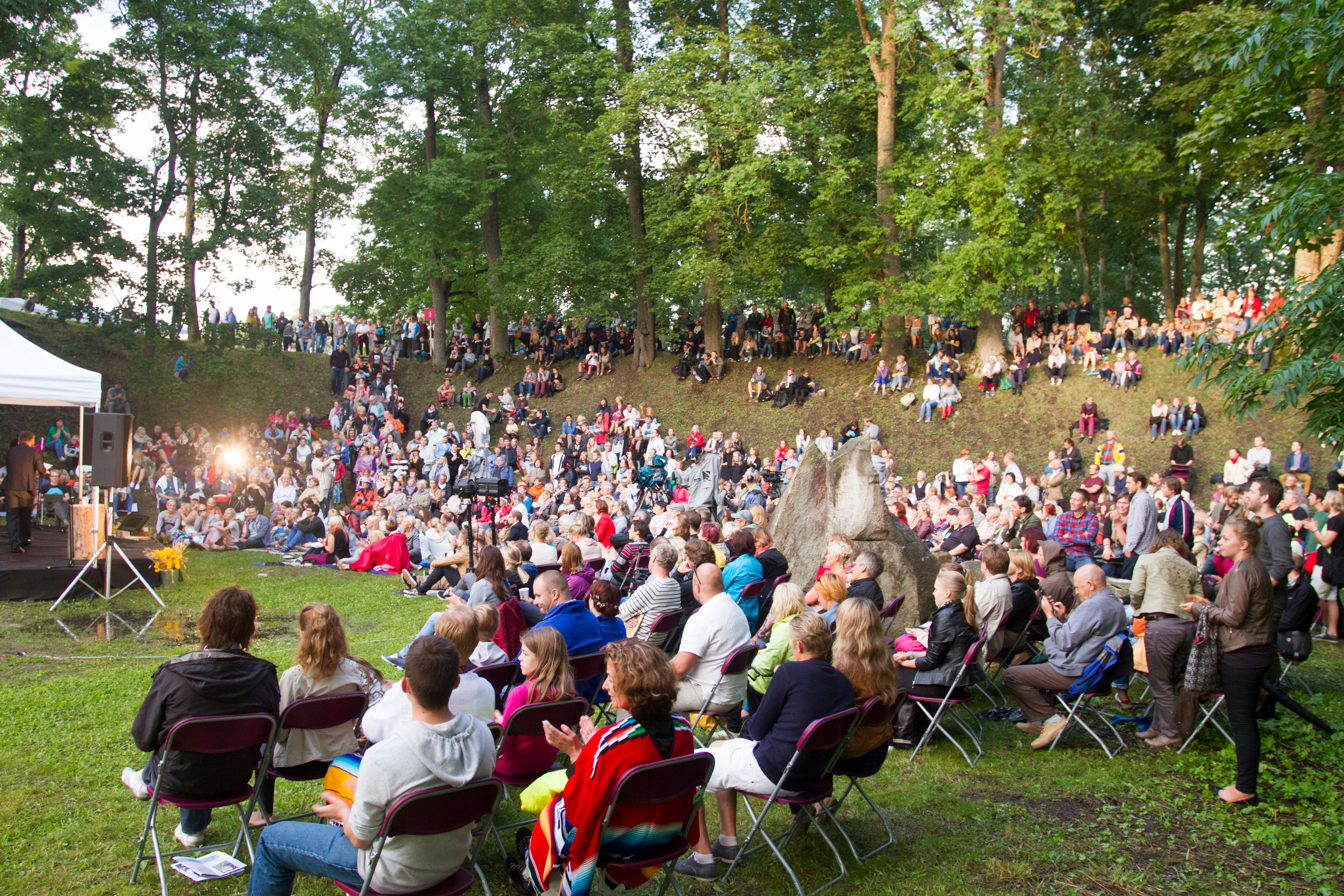
Arvamusfestival at Orulava in Paide, 2014. Photo: Alari Rammo / Wikimedia Commons, CC BY-SA 4.0. Unmodified.

A few weeks ago, I was sitting with my friend Lage under a tent in the ruins of a medieval castle in Paide, listening to Estonian entrepreneurs and officials talk about “building the agentic state”, giving unique e-IDs to AI agents and allowing them to act for you in the very advanced IT infrastructure that Estonia has built up. There were perhaps fifty people in the audience, and the whole conversation was in Estonian.
Lage and I do not speak Estonian, so we were both looking at our phones, where English captions continuously appeared as the panelists were speaking. Every once in a while a small card would pop up explaining an organization or policy that everyone else in the tent already knew about. Someone said something funny, the audience laughed, and a few seconds later we laughed too.
That last part was really amazing. I have read plenty of translated summaries after a conference, but this was different — we could hear the hesitation in someone's voice, notice which claim woke up the room, and understand the joke while it was still funny.
The next day we got a chance to interview Linnar Viik, one of the people behind Estonia's original Tiger Leap programme to bring computers to Estonian schools five years after independence, in 1996 , and now involved in AI Leap to bring socratic AI into all Estonian schools. We had just heard him on another panel, where he compared the tiny team that built Skype with the much larger teams inside companies like Google. So I asked him whether Estonia's small size helped it move a bit like a startup.
I could ask that because I had understood something he said in Estonian fifteen minutes earlier. (Interview in English below, first few minutes are in Norwegian).
In the Norwegian podcast we recorded afterwards I called this science fiction. Lage said, “It's science fiction, and it was incredibly fun.” I still think that is right. But I have been thinking just as much about how we ended up under exactly that tent, knowing who Linnar was, with enough background to ask him anything useful — and why I was sitting on my sofa a week later watching Soviet citizens argue about the future of Estonia in 1988.
This is where I started thinking about Douglas Adams and the Babel fish. His fish sits in your ear and translates. What we had in Estonia felt a bit larger: help finding a conversation we did not know existed, enough background to have a clue what people were talking about, and then the translation when we got there.
How do you prepare for a country you know almost nothing about?
Lage is spearheading an ambitious local project called the AI-club1, an attempt at bringing creative youth together with professional artists, museum curators, writers and filmmakers, and exploring the boundaries of what happens when artificial intelligence meets human intelligence. We had a bit of funding and the idea that we needed to get out and learn from what others are doing, and a vague instinct that something interesting was happening in Estonia around education, digital government, AI and civic participation.
But we weren’t even sure Tallinn was the right location, what would be the best time, or a single idea for whom to talk to. I asked Claude to investigate a few possibilities, and it came back unusually definite: go to Tallinn in early August, then take the bus to Paide for Arvamusfestival, Estonia's annual festival of public debate.
From there it became a proper rabbit hole. Claude churned through Estonian news reports, government strategies, research papers, programme documents and blog posts. AI listened to Estonian podcasts and helped us identify episodes and people connected to the questions we cared about. We gradually made a map of the education ministry, HARNO, the e-Estonia Briefing Centre, AI Leap, youth participation organizations and some of the people who had been around since the first wave of digital government.
One of the best meetings did not come from any clever search. I suddenly remembered someone I had been in a language class with in Russia more than twenty years ago. We had not kept in touch, and I had no idea what she was doing now. It turned out that she was working at Estonia's Ministry of Education and Research, doing incredibly relevant work to our interests (so fun seeing someone whose paths you crossed many years ago, and seeing that they have similar values and interests to you, in a very different context).
We booked a private session at e-Estonia briefing center and a meeting at the Ministry of Education with two people working on exactly the educational technology questions that interested us. The research also found a Nordic Council bus to Paide, the small town that hosted the democracy festival. Initially just a convenient way to get there, this turned out to be one of the best parts of the trip – several hours on a bus with people from the Nordics and the Baltics working on culture, resilience, dialogue, democracy and innovation. We started the festival even before we arrived in Paide.
Before the trip, I also had an AI research and write me a 105,000-word history of Estonia, targeted specifically at the questions I was curious about (and including plenty of poems and literary quotes for flavor), which I read on my Kindle. It had twenty-one chapters, eight maps and a private index checking hundreds of factual claims, because apparently this is how I pack now.
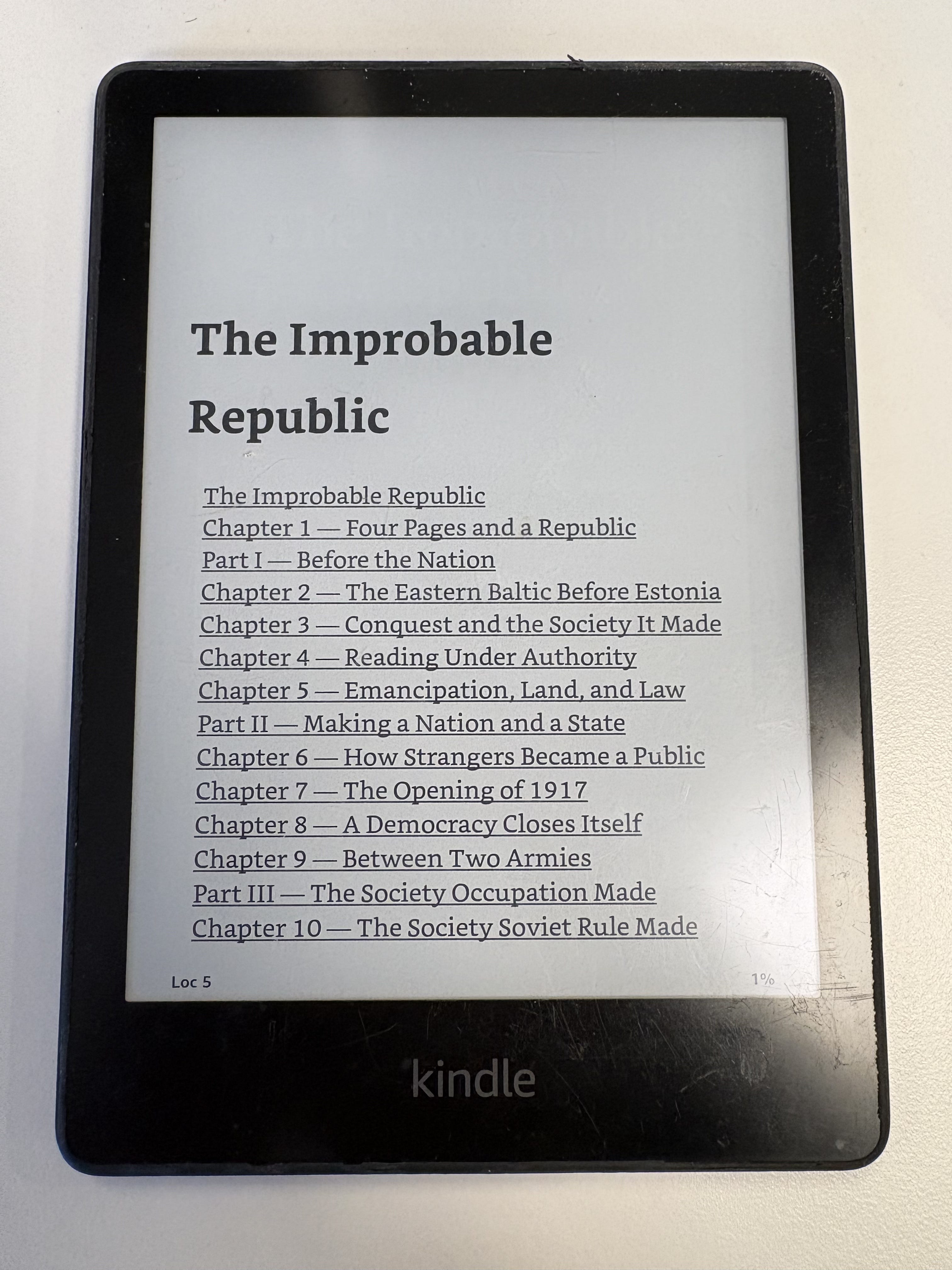
The private Estonia history on my extremely well-used Kindle.
This was, obviously, a somewhat ridiculous amount of preparation for a five-day trip, and reading a private, AI-written history book does not make me an Estonian historian. But it meant that when somebody mentioned the Singing Revolution, the 1992 constitution, Tiger Leap or the Bronze Soldier, I had at least something to attach the new information to. People did not have to begin every conversation at page one, and they could tell us where our neat little map was wrong.
I should also say that the people we contacted in Estonia were incredibly welcoming. People in ministries and public organizations made time for us, answered long emails, introduced us to others and seemed genuinely happy that two people from a small Norwegian town were interested in what they were doing. It probably helped that we were representing a UNESCO Creative City of Media Arts – a very nice program from UNESCO that helps make cities “legible”, and encourage twinning and collaboration across national borders.
Estonia has also made a very deliberate effort to explain and, yes, sell itself to foreigners — the e-Estonia Briefing Centre exists for exactly this reason — so we did not somehow hack our way into a closed system. They wanted visitors. But all the preparation meant that we had a lot more to talk about once we got there. And we were also able to locate interesting people and institutions outside of the “mainstream”.
Making Lage more “legible”, a thought-experiment
This reminds me of Lage's own work. While I have spent a lot of time around the world, and write and network in English, he has an incredibly deep history of engagement in Norway – he has written books, organized events, and spent years recording conversations with people around Hamar — artists, historians, teachers, theatre directors, military officers, local organizers and the people running institutions most of us pass every day without thinking much about them. The BYEN VÅR feed now has nearly a hundred episodes.
Imagine that someone in Italy comes across Lage's name and gets curious. A few years ago, searching for him in English might have produced a LinkedIn page and a few mysterious Norwegian event listings. All those hours of conversation would have been almost invisible.
Now they can find the podcast, transcribe it, translate it and begin asking questions across the whole archive. What does he keep returning to? Who are all these people in Hamar? How have his ideas about culture, education or civil preparedness changed? They could listen to the relevant pieces, and perhaps arrive in Hamar knowing that there was much more going on than they had found in the English search results.
This feels both fantastic and slightly alarming. Lage and I talked about it in a short Norwegian episode called “Kan ikke estisk, men forsto alt!” — “We Don't Speak Estonian, But Understood Everything!”. I said that the world had suddenly become much more transparent. Someone could do rich, peculiar, deeply local work for years, in a language spoken by five million people, and the rest of us might finally be able to find it.
For us in Hamar, of course, the interesting direction was the other one. We wanted access to the peculiar local work happening in Estonia.
The programme was in Estonian too
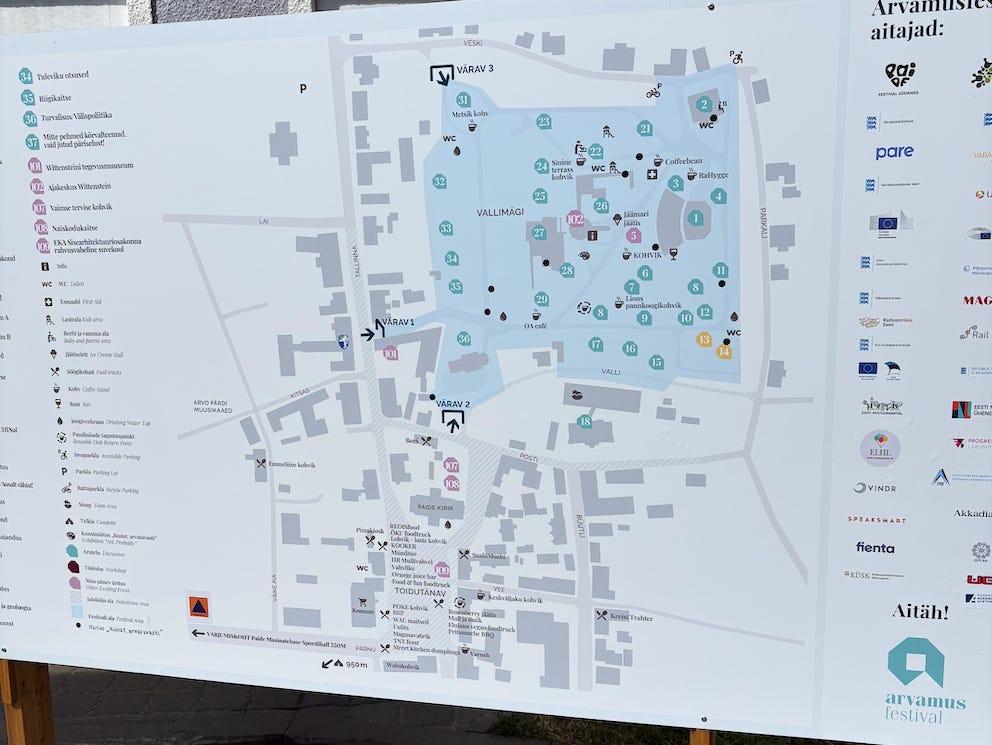
There was still the fairly obvious problem that almost the entire festival programme was in Estonian. Before we could understand a panel, we first had to know which tent it was in. So the little app I made contained an offline English version of all 304 programme entries, including the speakers and organizations.
Live transcription and translation is basically a solved problem now. I want to be quite clear about that: I did not invent a new way of translating Estonian. We could have opened an off-the-shelf app such as Soniox and read the English. I built my own because I am greedy and wanted more. I wanted the translated programme in the same place, the session we had chosen already attached when we pressed record, and little bits of background on the people, acronyms and organizations appearing in the discussion. Most importantly, I wanted to be able to change it immediately when it annoyed us.
I first called it Kaja, but during the festival it became Lotman, after Juri Lotman, the Tartu semiotician who spent his life thinking about translation between cultural systems.
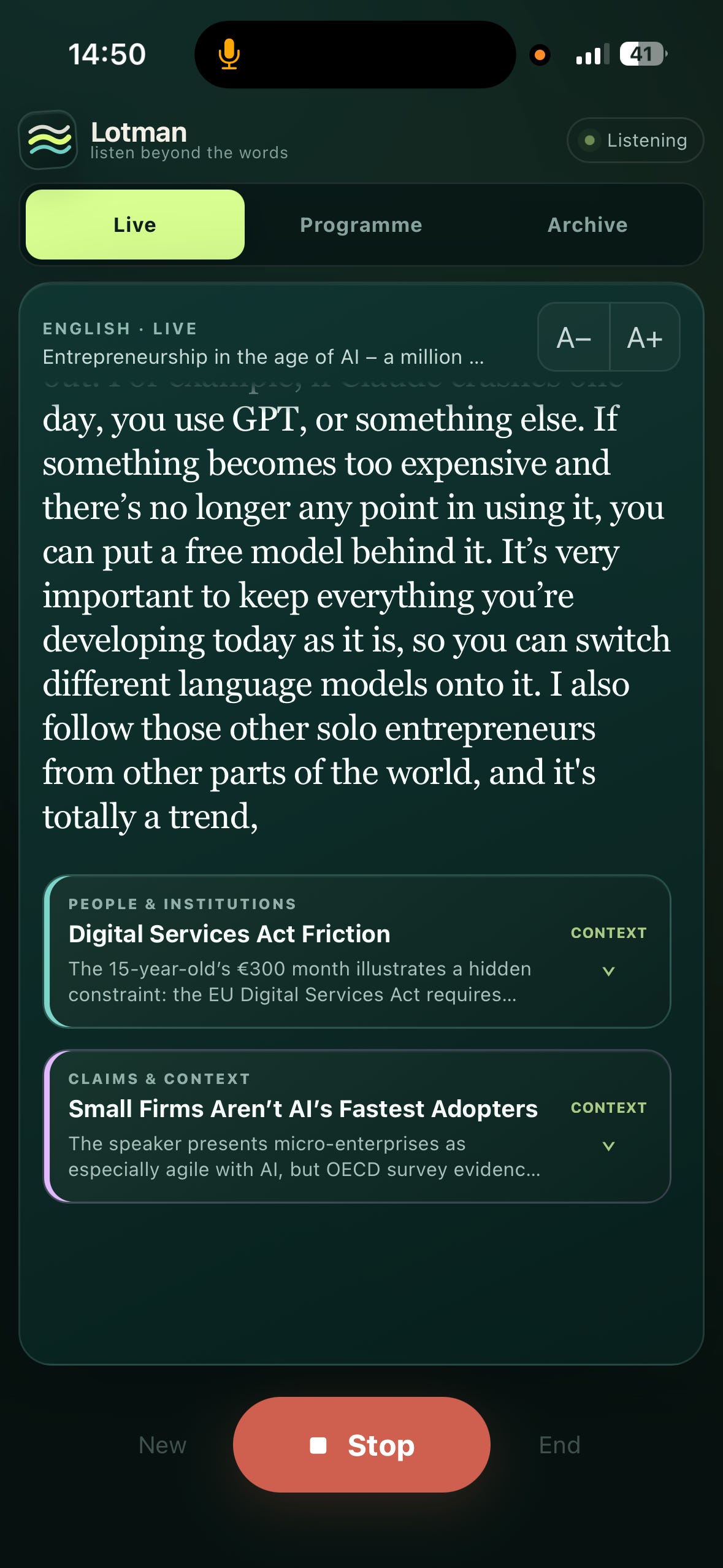
Lotman during an Arvamusfestival session: the translated programme, live English transcript and two of the experimental context cards.
The first version of the context layer was overwhelming. During one 91-minute session it produced 827 cards. If a speaker said that Estonia hoped to increase GDP by 25 percent, the app might interrupt to explain that this was a goal and not an established fact. Thank you. I understood that.
After using it for a while, I realized that I mostly wanted footnotes: What does this organization do? Where did that strange policy name come from? Why did a single acronym make everyone in the tent nod? We kept adjusting it during the festival (at one point over a beer, with Lage testing beside me), and it became genuinely useful. It still missed things and occasionally got in the way, but the cards became rarer and much more relevant. The translation itself had worked from the beginning; being able to shape everything around it was the reason for building our own version.
We used it during six sessions over the two festival days. Reading a phone for ninety minutes is tiring, and I would not pretend we caught every nuance, but it made us choose discussions we would otherwise have skipped. When the internet suddenly blipped, I looked up, completely disoriented. Suddenly I was just sitting in a foreign country where I did not understand a word. Then the internet came back and I could see again.
And when we sat down with Linnar Viik, we began the English interview with a question about something he had just said in Estonian.
After we came home
After coming home, I began poking around in the archives of Estonia's public broadcaster, ERR. They are full of documentaries, debates, theatre, literary programmes, school history, radio and political conversations going back decades. Much of it is available from Norway. Very little of it has English subtitles.
So I picked ten programmes I badly wanted to watch and made private English versions. The sources were all over the place: some programmes had automatic Estonian transcripts, one Russian-language programme had timed Estonian subtitles, and others needed fresh transcription and alignment. Names, institutions, quotations and old pieces of on-screen text needed checking. In the end I could push a programme into my private Jellyfin library and have the English subtitles appear automatically on the television.
There was even a 1990 Russian-language conversation with Juri Lotman about art and morality. I had named the festival app after him, and now the same subtitle project let me sit down and listen to him. A nice little circle.
Last night I watched parts of three programmes that I could barely have entered a week earlier.
The first was a 2023 Russian-language debate about AI in Estonian schools, and it provided a very interesting perspective on language and access. Estonia itself is multilingual in a challenging way. About 29% of the population speaks Russian, and many older residents (15%) do not understand or speak Estonian. Much of their news comes from Russia (which ERR is trying to address by providing more programming in Russian made by Estonians). The government recently decided that all schooling will switch to only Estonian-language by 2030.
And here I am watching a Russian-language programme, made in Estonia, about a Russian-speaking Estonian who wrote an essay for a competition, used ChatGPT to translate it to Estonian, and won a prize for it. Nobody was explaining Estonia to foreigners; this was a conversation inside Estonia’s Russian-speaking public sphere.
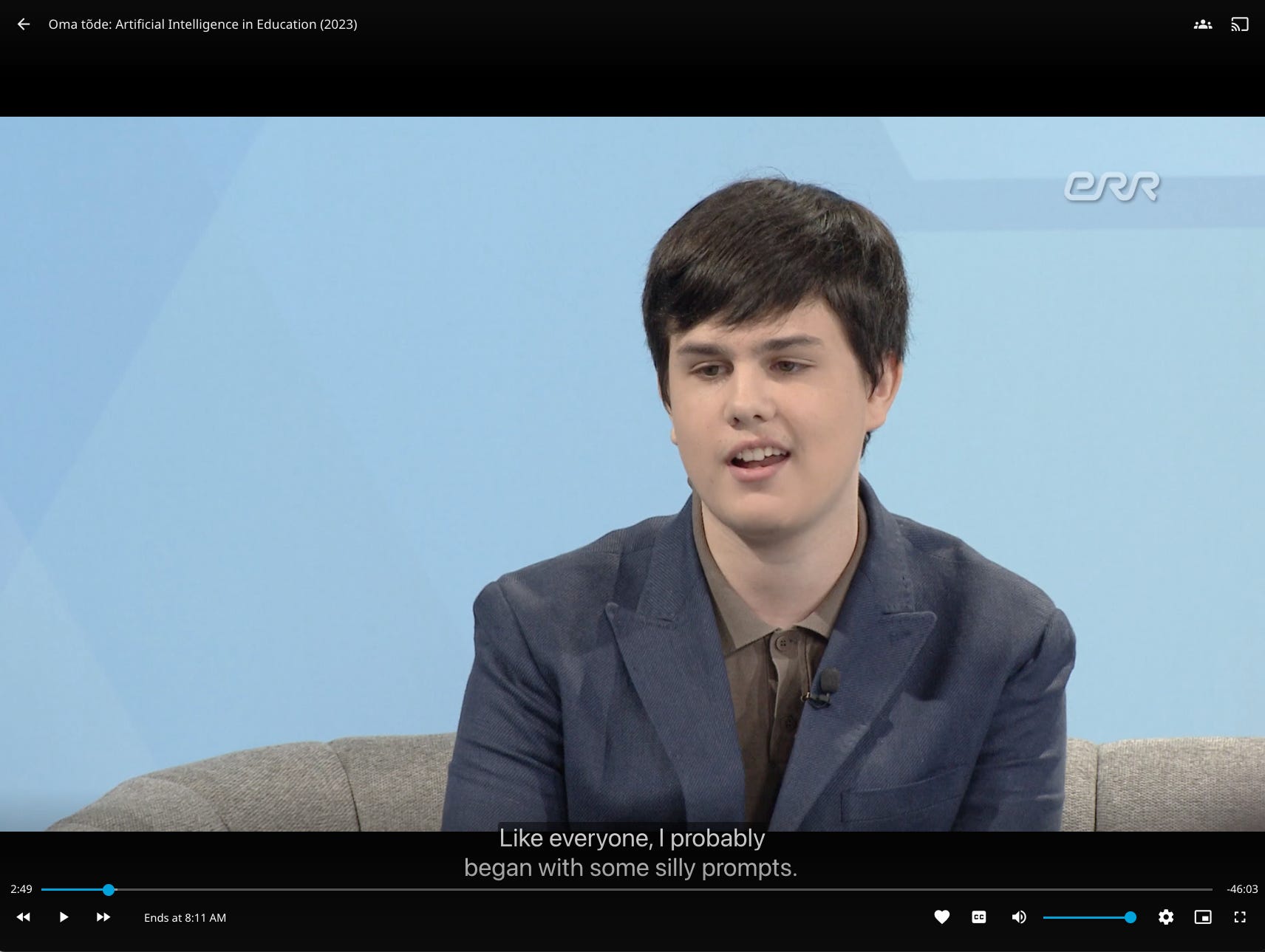
A Russian-language discussion about AI in Estonian schools (2023). Private research translation; programme © ERR.
Then I watched a 2013 programme about the People's Assembly, an experiment in deliberative democracy where proposals moved from an online platform through expert synthesis and briefing documents into discussions around small tables by a representative sample of citizens. They voted individually with keypads, saw the result on a screen, discussed it, and eventually sent proposals to Parliament. (I now have a long list of questions about why this format did not become more common, but that is probably another rabbit hole.)
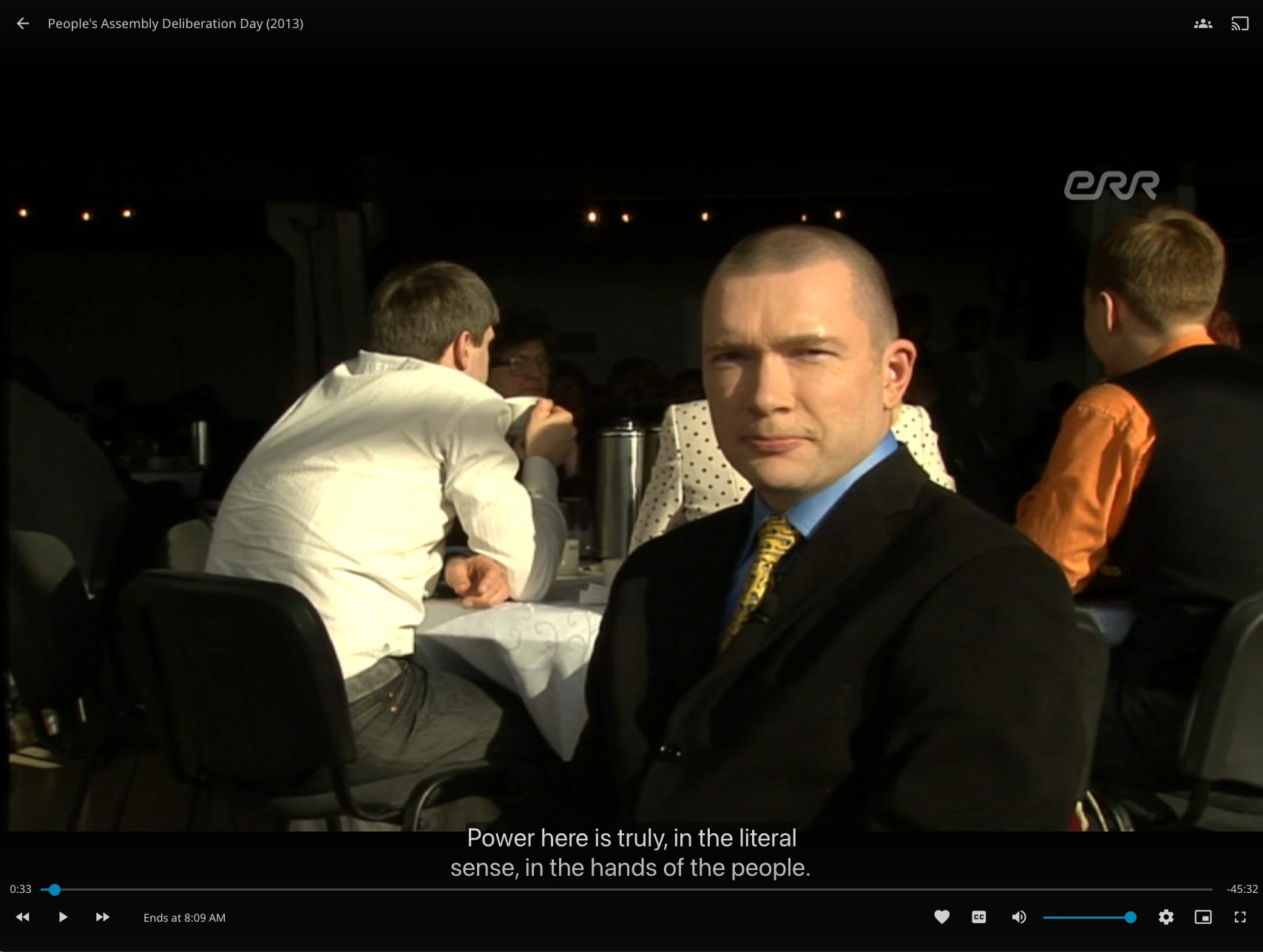
The People's Assembly deliberation day (2013). Private research translation; programme © ERR.
Finally I watched Mõtleme veel — Let's Think Further, broadcast live on 31 August 1988. This one gave me shivers.
Throughout its entire recorded history, Estonia had experienced only sixteen years of democracy – from 1918, before Konstantin Päts shut down political competition in 1934. And only about 22 years as a country at all. Then came Soviet occupation, Nazi occupation and Soviet rule again. Decades of Soviet industry and migration had brought a very large Russian-speaking population to Estonia — engineers assigned by ministries, factory workers, soldiers and families, some moving voluntarily and others sent through the Soviet system. Now perestroika had opened something, but nobody in the studio knew how far it would go, whether Estonia would become independent, or what kind of country it could possibly be.
Estonian politicians and scholars sat with Jewish, Armenian, Lithuanian, Ukrainian, Russian-speaking and Estonian-Swedish representatives. Was Estonia a multinational society, a mixed-nationality society or a national republic? Would making Estonian the official language protect a culture whose demographic majority had shrunk dramatically, or discriminate against Russian speakers? Who should become a citizen? What did sovereignty even mean while they were still inside the Soviet Union?
The programme opened by giving viewers three telephone numbers. The hosts explained that the discussion would continue almost until midnight, and that Russian simultaneous interpretation was available over VHF radio. Later they read calls into the studio — including Russian-speaking callers who believed the proposed citizenship rules were directed against them — and the people around the tables had to answer.
I kept imagining families around Estonia sitting up late, some listening to the Russian interpretation on the radio, arguing with the television and with each other, and occasionally picking up the phone. These were not historians calmly explaining why independence happened. They were trying out the words while the outcome was still open.
You can read a very good book about 1988 and understand all the events, but I don't think it can quite reproduce the feeling of watching these people search for the country in real time — the pauses, the irritation, the jokes, the callers, the worried politeness when they disagree. I was sitting on my sofa in Hamar, watching this time capsule from a pivotal night, and able to follow it.
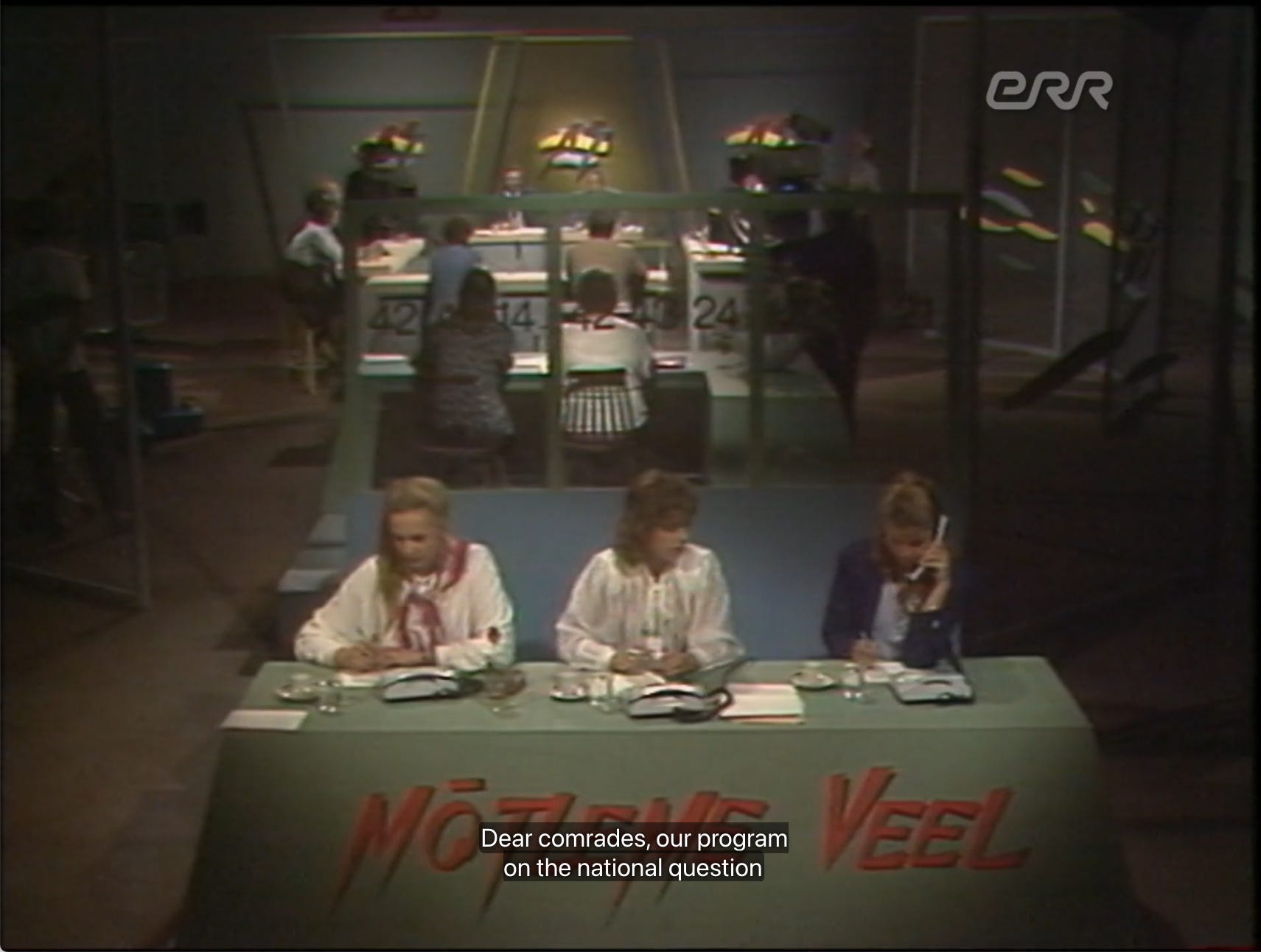
“Dear comrades, our programme on the national question…” The opening of Let's Think Further (1988). Private research translation; programme © ERR.
What I think is new
Machine translation is not new. Google Translate has been around for twenty years, and live captions are no longer especially exotic. What seems new to me is all the stuff around the sentence. I can search in Estonian before I know which words to use, find a podcast, make dozens of hours of audio searchable, look up an institution, turn a festival programme into something we can use, follow the discussion, and then go home and keep watching.
Europe is full of things like this. From Hamar, a short flight or train ride takes me into another language, with its own public broadcaster, local historians, teachers, political arguments and odd little institutions. I do not want all of it converted into English. The reason Lage's podcasts are interesting is precisely that they are local, in Norwegian, made for people who know what Koigen is and have opinions about the future of Hamar. I just want someone in Estonia — or Indonesia, or India — to be able to discover that the conversation exists and listen for a while. To find us, reach out, and have a dialogue.
The slightly alarming part of the Lage thought experiment is that the stranger in England might be trying to understand his work, or they might be compiling a political dossier, searching ninety-eight conversations for one sentence to pull out of context, and asking a model to pronounce confidently on what he “really believes.” I don't quite know where the boundary is. Something being available on the open web has never meant that its creator imagined being profiled across their entire life in an afternoon.
And translation can make us feel that we understand much more than we do. In Mõtleme veel, for example, the word rahvus sometimes meant “nation” and sometimes “nationality” — the shifting meaning was part of the disagreement. Rahvusvabariik was a Soviet “national republic,” which is not quite the same as an English “nation-state.” A beautifully smooth translation could easily decide the argument on behalf of the people having it. Irony disappears too, a hesitant suggestion becomes a claim, and you have no idea about the history between two people at the table.
Douglas Adams' Babel fish was not exactly a utopian invention. Once everyone could understand everyone else, they discovered plenty of new things to fight about.
Years ago, while researching open educational resources in China, India, Indonesia and Pakistan, each discovery felt like finding a room in your own house that you had never known existed. Millions of people were teaching, publishing and learning there, almost completely invisible from the English-speaking web. I was so excited by this potential to “peek into” classrooms around the world that I made a little music video:
Now I keep wondering how many of those rooms I have walked past because I did not know what to search for. I am sure the translations will sometimes make me overconfident, and then I will need someone inside to tell me what I have misunderstood. It’s still all about the people, but if I use AI correctly, I can find the people doing really interesting stuff, and reach out to them. And ask them to explain to me!
A month ago, the people in that 1988 studio were search results I could not read, in a programme I did not know existed. Last night they were arguing in my living room.
What extraordinary local conversation is happening in your language that the rest of us don't know about? And what would you want an outsider to understand before they came through the door?
Stian